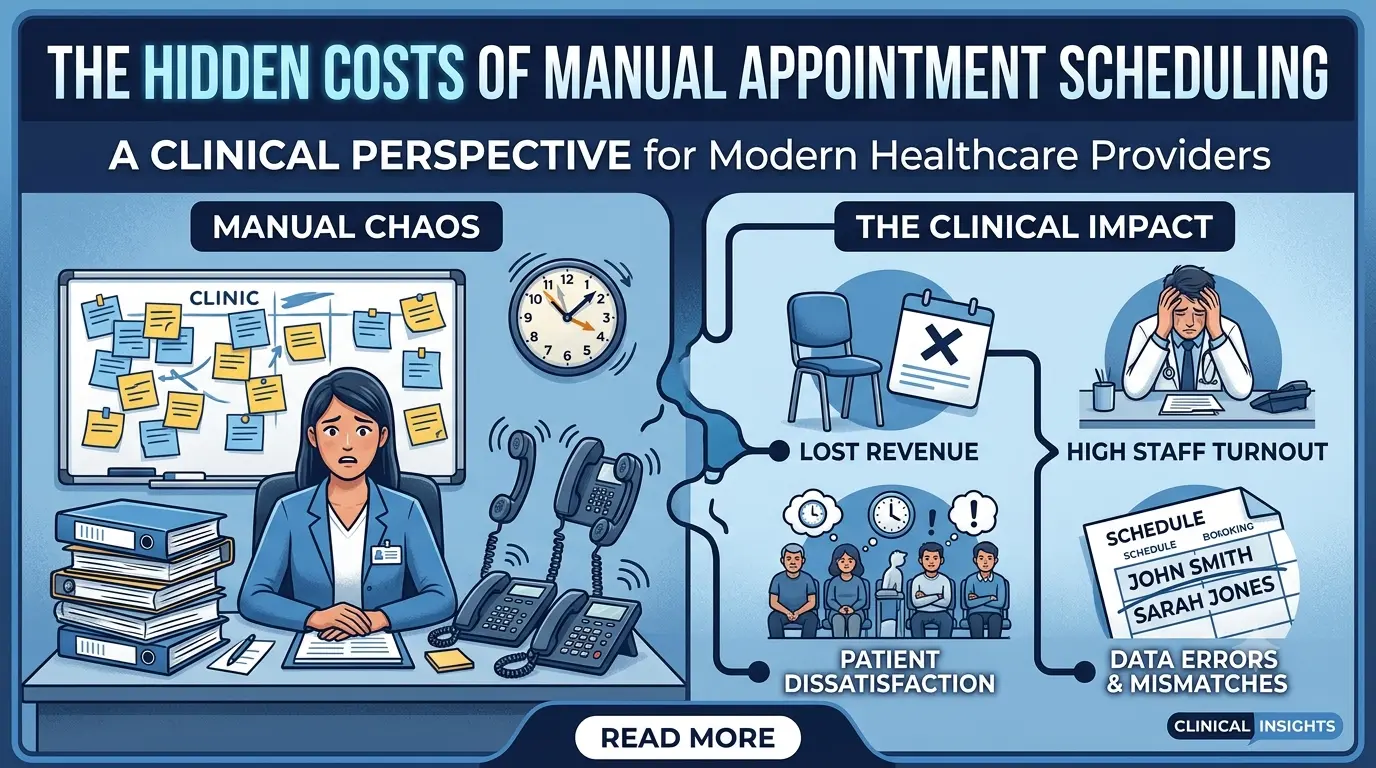
The Hidden Costs of Manual Appointment Scheduling: A Clinical Perspective for Modern Healthcare Providers

ProKliniK Editorial Team
Editorial Team • January 15, 2026
Introduction
In the high-stakes environment of modern healthcare, time is not merely a currency; it is a critical resource that directly correlates with patient outcomes, operational efficiency, and financial viability. For clinics ranging from primary care practices to specialized dermatology centers, managing appointments is not simply an administrative function—it is the lifeblood of clinical operations.
Yet, despite its centrality, many healthcare providers continue to rely on fragmented manual methods for scheduling: shared physical calendars, disparate spreadsheets, or uncoordinated digital tools that lack real-time synchronization. These outdated practices are not merely inconvenient; they represent a significant drain on clinical capacity and financial resources.
The true expense of manual appointment scheduling lies in the invisible, compounding losses that accumulate daily: lost revenue from no-shows and double-bookings, administrative inefficiencies that erode physician productivity, compromised patient experience leading to churn, and an inability to scale operations without a linear increase in overhead costs.
This comprehensive guide, crafted with the insights of **Proklinik-one**, the leading clinic management SaaS solution, delves deep into the mechanics of manual scheduling within healthcare settings. We will quantify its financial impact using clinical data points, reveal the strategic advantages of transitioning to integrated automated appointment systems, and demonstrate how Proklinik-one transforms chaotic coordination into a streamlined engine for patient care and revenue growth.
The Myth of "Free" Manual Scheduling in Healthcare
The most pervasive argument against automation in healthcare is the perceived cost savings. A manual scheduling system—whether it involves a physical wall calendar in the reception area, a shared Google Calendar without integration, or a standalone spreadsheet—appears to be free.
There are no monthly subscription fees, no per-user charges for electronic health record (EHR) modules, and no implementation costs beyond the initial time investment of setting up the paper system. However, this "free" label ignores the true cost of opportunity in a clinical context.
When a practice does not pay for integrated scheduling software, it is effectively paying with its physicians' billable hours and its clinic's potential revenue. The cost of manual scheduling must be understood as an **opportunity cost**: the value of clinical time that could be spent on patient care if it weren't being wasted on coordination tasks.
Consider a mid-sized primary care practice where two front-desk staff members manage appointments manually. While they are not directly billing patients, their time represents a significant portion of the clinic's operational capacity. If these staff members spend 25% of their week coordinating schedules, resolving conflicts between providers, and chasing reminders, that is effectively 10 hours of lost productivity per day.
In an industry where average hourly rates for administrative support range from $40 to $65, this translates to thousands of dollars in wasted labor costs annually. Furthermore, the "free" nature of manual systems creates a false sense of security among clinic owners.
Because there are no recurring bills, practices often delay upgrading their technology until it becomes absolutely necessary during an audit or a revenue cycle review. This reactive approach means they continue to operate with inefficient processes while competitors who have invested in integrated automation are capturing market share, improving their own margins, and offering superior patient experiences.
The Revenue Leak: No-Shows and Cancellations in Clinical Settings
One of the most significant hidden costs of manual scheduling in healthcare is the high rate of no-shows and last-minute cancellations. Without automated reminder systems, SMS confirmations, or integrated rescheduling features, clinics struggle to maintain accurate attendance records.
In a medical context, this is not just about lost revenue; it disrupts care continuity and strains resources. For example, a dermatology clinic might charge $150 per consultation. If 20% of their appointments are no-shows—a common figure for manual systems—that represents $3,600 in direct lost revenue every month from just one missed patient.
More critically, these slots remain empty until the next available time, during which the clinic is unable to generate any income or provide care. Manual systems also lack the flexibility to accommodate last-minute changes efficiently.
When a patient cancels an hour before their appointment due to illness or emergency, manual schedulers often have to manually update calendars, notify other staff members, and potentially find alternative patients to fill the gap. This process is time-consuming and prone to human error.
Automated systems, by contrast, can automatically send cancellation notifications via text or email, offer alternative time slots instantly, and even rebook new patients into freed-up slots without lifting a finger from the keyboard. The psychological impact of manual scheduling on patient behavior cannot be overstated in a clinical setting.
When patients interact with a disorganized calendar system, they often feel less valued and more anxious about their visit. This lack of professionalism can lead to reduced trust in the practice, causing patients to choose competitors who offer a smoother, more reliable booking experience—a phenomenon known as "churn" that is particularly damaging for specialty clinics relying on referrals.
The Double-Booking Nightmare: Risks to Patient Safety and Reputation
Double-bookings are perhaps the most visible symptom of manual scheduling failures in healthcare, yet they represent a massive hidden cost in terms of reputation damage, potential liability, and operational chaos. When two patients are scheduled for the same time slot without an automated conflict-checking mechanism linked to the provider's schedule, the result is almost always a disaster.
The immediate consequences include angry patients who feel disrespected, staff members scrambling to resolve the issue on the spot, and potential cancellations or refunds that eat into revenue. Beyond the immediate financial loss, double-bookings create a ripple effect throughout the clinic.
They disrupt workflows, cause delays in care delivery, and increase stress levels among employees. In severe cases, they can compromise patient safety if a provider is forced to split their attention between two patients simultaneously.
In manual systems, resolving a double-booking requires significant human intervention. The scheduler must contact both patients, apologize, offer alternative times, and manually update multiple calendars or paper logs. This process not only wastes valuable time but also exposes the clinic to liability if the situation is mishandled.
Automated scheduling software eliminates this risk entirely by preventing conflicts before they occur through real-time calendar synchronization and validation across all providers in the network.
Administrative Inefficiencies and Productivity Losses: The "Non-Billable" Tax
The administrative burden of manual scheduling extends far beyond simple coordination in a clinical environment. It encompasses a wide range of tasks that consume employee time but generate no direct revenue, often referred to as "non-billable hours." These include:
* **Calendar Maintenance:** Manually updating calendars when staff members change shifts, take sick leave (a common occurrence in healthcare), or join the team requires constant vigilance and manual entry.
* **Reminder Management:** Sending follow-up emails or texts to confirm appointments, remind patients of upcoming visits, send pre-visit instructions, and collect post-appointment feedback forms is a tedious task that manual schedulers must handle individually for every patient.
* **Conflict Resolution:** Dealing with overlapping bookings, time zone differences (for telehealth), special requests, and provider availability requires constant communication and manual adjustments across multiple platforms.
* **Data Entry:** Recording appointment details, patient preferences, insurance information, and clinical notes in various systems often involves redundant data entry across different tools, increasing the risk of errors.
These tasks collectively represent a significant drain on productivity. Studies have shown that administrative tasks can consume up to 30% of an employee's work week in service-based businesses, but in healthcare, this figure is often higher due to the complexity of patient records and regulatory compliance needs.
When this time is dedicated solely to scheduling, it directly reduces the capacity for revenue-generating activities such as patient acquisition, clinical care delivery, and business development. Moreover, manual systems often lack integration with other critical business functions like Practice Management Software (PMS), Electronic Health Records (EHR), or accounting software.
This siloed approach means that appointment data is not easily accessible or actionable, making it difficult to analyze trends, forecast demand, optimize provider schedules, or manage revenue cycle efficiency. The inability to derive insights from scheduling data further compounds the inefficiency.
Patient Experience and Brand Reputation: The Digital Touchpoint
In today's digital age, patient experience is a primary differentiator in competitive healthcare markets. Manual scheduling systems often fail to deliver a seamless booking process, leading to frustration and dissatisfaction among patients.
When users encounter long wait times, confusing interfaces, lack of communication during the booking process, or inability to reschedule easily, their perception of the clinic suffers immediately. A poor scheduling experience can have lasting effects on patient retention and referral rates in healthcare.
Satisfied patients are more likely to return for follow-up care, recommend the clinic to others, and complete necessary treatment plans. Conversely, a frustrating booking experience can lead to negative reviews on platforms like Google or Healthgrades, social media complaints, and ultimately, lost market share.
Automated scheduling systems address these pain points by providing a user-friendly interface, instant confirmation, automated reminders, flexible rescheduling options, and even telehealth integration. These features not only improve the patient experience but also reinforce the clinic's commitment to efficiency and professionalism.
Scalability Challenges and Growth Barriers: The Ceiling of Manual Operations
One of the most significant limitations of manual scheduling is its inability to scale effectively as a clinic grows. As the number of appointments increases, so does the complexity of managing them manually.
This creates a bottleneck that limits growth potential and requires disproportionate increases in headcount to handle additional volume. For example, doubling the number of patients might require hiring two new receptionists, but it also doubles the coordination challenges associated with manual scheduling.
The result is often diminishing returns on investment, where each additional employee contributes less to overall efficiency than the previous one due to increased complexity in managing multiple calendars and staff schedules. In contrast, automated systems scale effortlessly.
Adding more appointments does not increase administrative overhead; in fact, it can lead to higher utilization rates and improved revenue per staff member. This scalability issue becomes particularly problematic during peak seasons (e.g., flu season) or periods of rapid growth.
Manual systems often break down under pressure, leading to overwhelmed staff, missed opportunities for new patient acquisition, and a decline in service quality. Automated solutions provide the infrastructure needed to handle increased volume without compromising on efficiency or patient satisfaction.
The Human Factor: Employee Burnout and Turnover Rates
The stress of manual scheduling contributes significantly to employee burnout and turnover rates in healthcare administration. Receptionists and schedulers often find themselves trapped in a cycle of constant interruptions, conflict resolution, administrative drudgery, and the pressure of managing complex patient schedules.
This high-pressure environment leads to job dissatisfaction, increased absenteeism, and higher turnover costs. High turnover rates have profound implications for clinic operations.
Recruiting and training new staff is expensive and time-consuming, disrupting workflows and reducing productivity during the transition period. Furthermore, frequent changes in key personnel can lead to inconsistent scheduling practices and a loss of institutional knowledge regarding patient preferences and provider availability patterns.
By automating scheduling tasks, clinics can alleviate the burden on their administrative teams, allowing them to focus on more strategic and engaging responsibilities such as patient engagement initiatives or quality improvement projects. This improvement in job satisfaction not only reduces turnover but also enhances employee morale and productivity.
Quantifying the Hidden Costs: A Financial Perspective for Clinic Owners
To truly understand the magnitude of these hidden costs, let's examine a hypothetical scenario involving a mid-sized primary care clinic with 5 physicians and an average monthly revenue of $100,000 from appointments.
**Current Manual System Costs:**
* **Lost Revenue from No-Shows:** Assuming a 25% no-show rate across 60 weekly appointments (480 per month), that's 120 missed appointments. At an average value of $100 per appointment, this equals $12,000 in lost revenue monthly ($144,000 annually).
* **Double-Bookings:** Occurring twice a week on average, each resulting in a cancellation and refund plus reputational damage and potential liability exposure, costing approximately $600 in direct losses and indirect costs. This totals $12,000 annually.
* **Administrative Labor:** Two receptionists spending 20 hours per week on scheduling tasks (40 hours combined monthly). At an average wage of $35/hour plus benefits ($15/hour), the cost is $600/month or $7,200 annually.
* **Inefficiency Losses:** The time spent resolving conflicts and updating calendars could be used for patient outreach or care coordination. Valuing this at $45/hour (opportunity cost), 15 hours of lost productivity weekly translates to $48,600 annually.
**Total Annual Hidden Cost:** Approximately $327,600 in direct and indirect losses.
Now, consider the investment required for an integrated automated scheduling system like **Proklinik-one**:
* **Software Subscription:** Typically ranges from $50 to $100 per user/month (including EHR integration). For 15 users (physicians, staff, etc.), this is roughly $9,750 annually.
* **Implementation Time:** Estimated at 4-6 hours of setup time, equivalent to less than one day of labor.
**Net Benefit:** The automated system would save the clinic approximately $318,000 annually while simultaneously improving patient experience and operational efficiency. This represents a return on investment (ROI) of over 3,200% in just the first year alone.
This calculation demonstrates that manual scheduling is not merely an inconvenience; it is a significant financial liability that undermines clinic profitability and growth potential. The numbers speak clearly: the cost of doing nothing is far greater than the cost of investing in integrated automation.
Strategic Advantages of Automated Scheduling Systems: The Proklinik-one Advantage
Transitioning from manual to automated appointment scheduling offers numerous strategic advantages beyond mere cost savings. These benefits transform how clinics operate, interact with patients, and compete in their markets, specifically leveraging the capabilities of **Proklinik-one**.
**1. Enhanced Patient Retention and Loyalty:** Automated systems provide a consistent, reliable booking experience that builds trust and loyalty. Features like instant confirmations via SMS/Email, easy rescheduling, automated reminders, and personalized follow-ups demonstrate a commitment to patient convenience.
This improved experience increases the likelihood of repeat visits, adherence to treatment plans, and referrals, creating a virtuous cycle of growth unique to modern clinic management software.
**2. Data-Driven Decision Making:** Modern scheduling platforms like Proklinik-one provide rich analytics on booking patterns, peak times, patient preferences, no-show rates, and provider utilization.
This data enables clinics to optimize their schedules, adjust pricing strategies (if applicable), make informed decisions about staffing and resource allocation, and identify trends in demand. With manual systems, such insights are virtually impossible to obtain accurately, leading to suboptimal resource management.
**3. Seamless Integration with Clinical Ecosystems:** Automated scheduling software integrates seamlessly with other critical business functions like Electronic Health Records (EHR), Practice Management Software (PMS), billing systems, and telehealth platforms.
This creates a unified ecosystem where appointment data flows freely between systems, eliminating silos and enabling holistic clinic management. Manual systems often require manual data transfer between disparate tools, creating friction, errors, and compliance risks.
**4. Competitive Differentiation in Healthcare Markets:** In crowded healthcare markets, the ability to offer a superior booking experience can be a key competitive advantage. Clinics that provide smooth, efficient scheduling processes stand out from competitors who rely on outdated methods.
Overcoming Implementation Barriers: A Guide for Clinic Leaders
Despite the clear benefits, many clinic owners hesitate to adopt automated scheduling systems due to concerns about complexity, cost, or disruption to current operations. Addressing these barriers is essential for successful implementation using solutions like Proklinik-one.
**Concern 1: Complexity and Learning Curve:** Many clinics fear that new software will be too complex for their staff to use effectively. However, modern scheduling platforms are designed with user-friendliness at the forefront, specifically tailored for healthcare workflows.
Most systems offer intuitive interfaces, comprehensive training resources (including video tutorials), customer support, and seamless integration with existing EHRs to ensure smooth adoption. The initial learning curve is typically short, and ongoing support ensures continued success in managing complex patient schedules.
**Concern 2: Cost Concerns:** While some clinics worry about subscription costs, it's important to remember that manual scheduling costs far more in hidden expenses. When viewed holistically—including lost revenue, administrative labor, inefficiencies, and potential liability—the cost of automation becomes a fraction of the total cost of doing business manually.
**Concern 3: Disruption to Current Operations:** Switching systems can seem disruptive during busy periods. However, careful planning and phased implementation can minimize disruption. Many clinics successfully transition by running both systems simultaneously for a period (if needed), training staff thoroughly beforehand, leveraging the new system's efficiency to quickly recover lost productivity.
Future Trends in Appointment Scheduling: The Next Generation of Clinic Management
The landscape of appointment scheduling is evolving rapidly, driven by advances in technology and changing patient expectations. Several trends are shaping the future of this field, and **Proklinik-one** is at the forefront of these innovations:
**Artificial Intelligence (AI) Integration:** AI-powered features are becoming increasingly common, offering capabilities such as predictive scheduling (anticipating demand based on historical data), intelligent chatbots for initial patient inquiries, automated optimization of staff schedules to maximize efficiency, and dynamic pricing models.
**Mobile-First Design:** As patients become more mobile-dependent, scheduling platforms are prioritizing mobile experiences with features like QR code booking, dedicated mobile apps, location-based services for telehealth, and push notifications. This trend reflects the growing expectation that patients should be able to book appointments on-the-go with ease.
**Virtual and Hybrid Models:** The rise of remote work and virtual consultations has expanded the scope of what can be scheduled. Modern platforms now support hybrid models, allowing clinics to manage both in-person and virtual appointments from a single interface.
**Personalization at Scale:** Advanced analytics enable personalized scheduling experiences tailored to individual patient preferences and behaviors. This level of customization enhances the overall patient journey, strengthens brand loyalty, and improves adherence to care plans by respecting patient autonomy and convenience.
Conclusion: Investing in Efficiency is Investing in Growth for Your Clinic
The hidden costs of manual appointment scheduling are substantial, affecting every aspect of clinic operations from revenue generation to employee satisfaction and patient safety. From lost revenue due to no-shows and double-bookings to administrative inefficiencies and scalability limitations, the impact of manual systems is profound and pervasive in the healthcare sector.
Transitioning to automated appointment scheduling is not merely a technological upgrade; it is a strategic imperative for any clinic serious about growth, profitability, and quality patient care. The investment in automation pays for itself quickly through reduced operational costs, increased revenue from better utilization, improved patient experiences that drive retention and referrals, and enhanced compliance with regulatory standards.
Clinic owners who recognize the true cost of manual scheduling are making a critical decision to future-proof their operations. By embracing integrated automated solutions like **Proklinik-one**, they unlock new levels of efficiency, scalability, and patient satisfaction that were previously impossible to achieve with traditional methods.
In an era where competition is fierce and patient expectations are high, staying ahead requires more than just good clinical care—it requires smart systems that support excellence at every touchpoint. The time to act is now. By making the switch to automated solutions, clinics can reclaim their time, boost their bottom line, and position themselves for sustained success in an increasingly dynamic healthcare marketplace.
**Proklinik-one** stands ready to transform your scheduling challenges into opportunities for growth, ensuring that every minute counts toward better patient outcomes and a healthier bottom line.
Related Articles

Why Every Modern Clinic Needs a Clinic Management System in 2026
Running a successful clinic in 2026 requires more than excellent medical care. Patients expect online booking, shorter waiting times, digital communication, and efficient service. This guide explains how a clinic management system helps improve operational efficiency, increase revenue, reduce administrative workload, and deliver a better patient experience while preparing clinics for future growth.

How Digital Clinics Deliver Better Patient Experiences
In the modern healthcare landscape, patient experience (PX) is a critical differentiator. Digital clinics leverage technology to reduce wait times, streamline communication, and provide seamless access to care. This article explores how Proklinik-one empowers clinics to transform digital infrastructure into superior patient journeys.

15 Signs Your Clinic Has Outgrown Paper Records
Is your medical practice still buried under stacks of paper charts? Relying on physical medical files slows down your workflow, increases administrative errors, and compromises data security. This extensive guide highlights the 15 definitive signs that your clinic has outgrown traditional paper records and why transitioning to a cloud-based Electronic Medical Records (EMR) system is essential for your growth in 2026.